Address
304 North Cardinal
St. Dorchester Center, MA 02124
Work Hours
Monday to Friday: 7AM - 7PM
Weekend: 10AM - 5PM
Address
304 North Cardinal
St. Dorchester Center, MA 02124
Work Hours
Monday to Friday: 7AM - 7PM
Weekend: 10AM - 5PM
Serving a heifer too early or under the wrong conditions can cost you more in the long run, from poor conception rates to calving complications and stunted milk production.
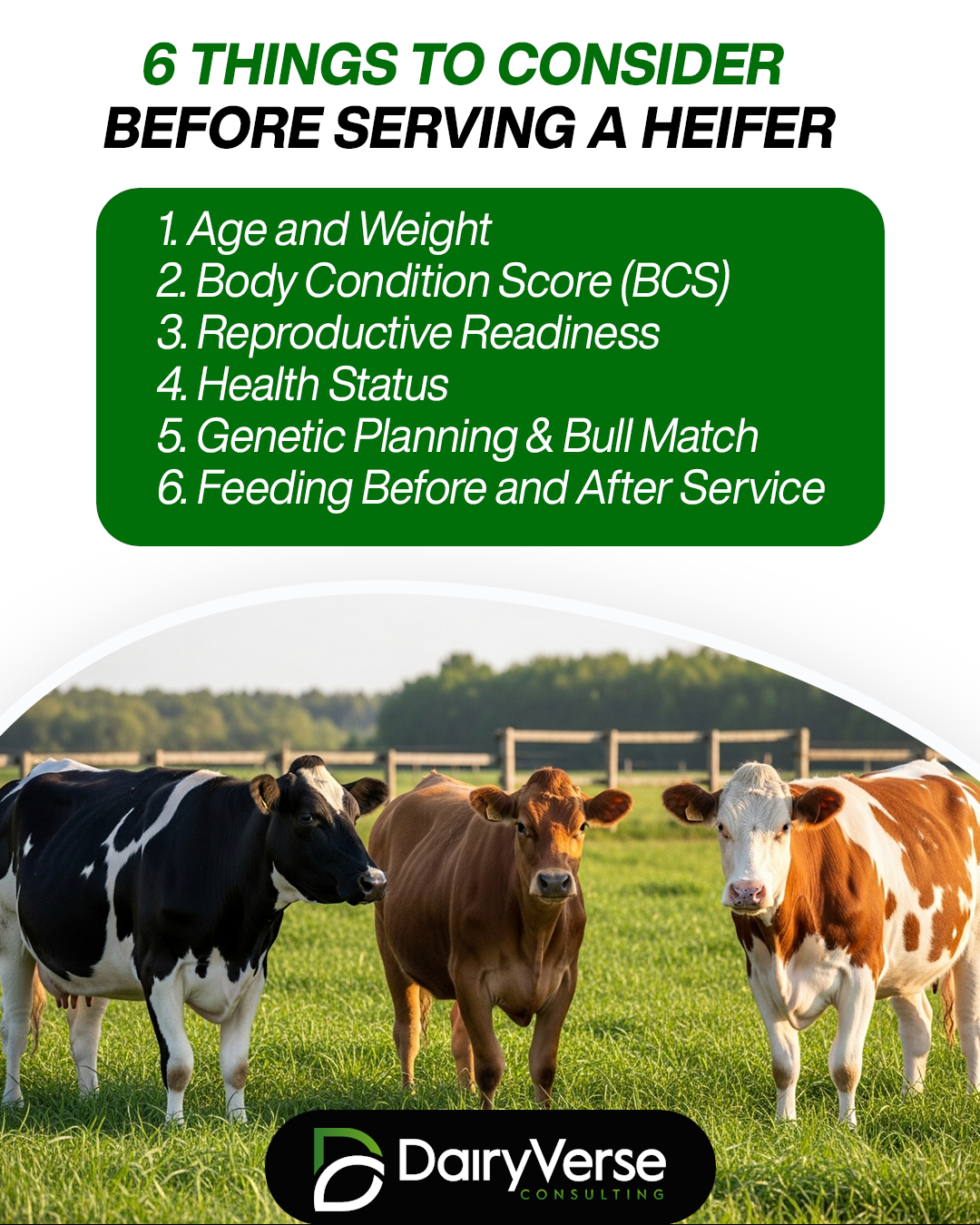
Serving a heifer too early or under the wrong conditions can cost you more in the long run — from poor conception rates to calving complications and stunted milk production.
Here are 6 key things to check before deciding she’s ready:
Heifers should be at least 15–18 months old and have reached 60–70% of their mature body weight.
Too young or too light = poor pregnancy outcomes.

She should have a moderate BCS of 2.5–3.5 (on a 5-point scale).
Too fat = calving problems. Too thin = poor fertility.
She must have shown at least one or two normal heat cycles.
Don’t serve a heifer that hasn’t cycled naturally.
Ensure she’s dewormed, vaccinated, and in good health.
No signs of disease, lameness, or stress.
Choose a bull with calving ease genetics to avoid hard births.
Avoid serving her with large or aggressive bulls.
A heifer needs proper nutritional support before and after service.
Low energy or mineral deficiency at this stage can lead to early embryo loss or weak pregnancy. Support her with balanced feed and mineral licks.
Serving a heifer is a long-term decision. When done right, it leads to better fertility, easier calving, and stronger lifetime production.