Address
304 North Cardinal
St. Dorchester Center, MA 02124
Work Hours
Monday to Friday: 7AM - 7PM
Weekend: 10AM - 5PM
Address
304 North Cardinal
St. Dorchester Center, MA 02124
Work Hours
Monday to Friday: 7AM - 7PM
Weekend: 10AM - 5PM
As livestock farmers, we often focus on what we can measure, milk litres, feed amounts, conception rates. But sometimes, the most accurate health indicators are right in front of us, quietly telling a deeper story.
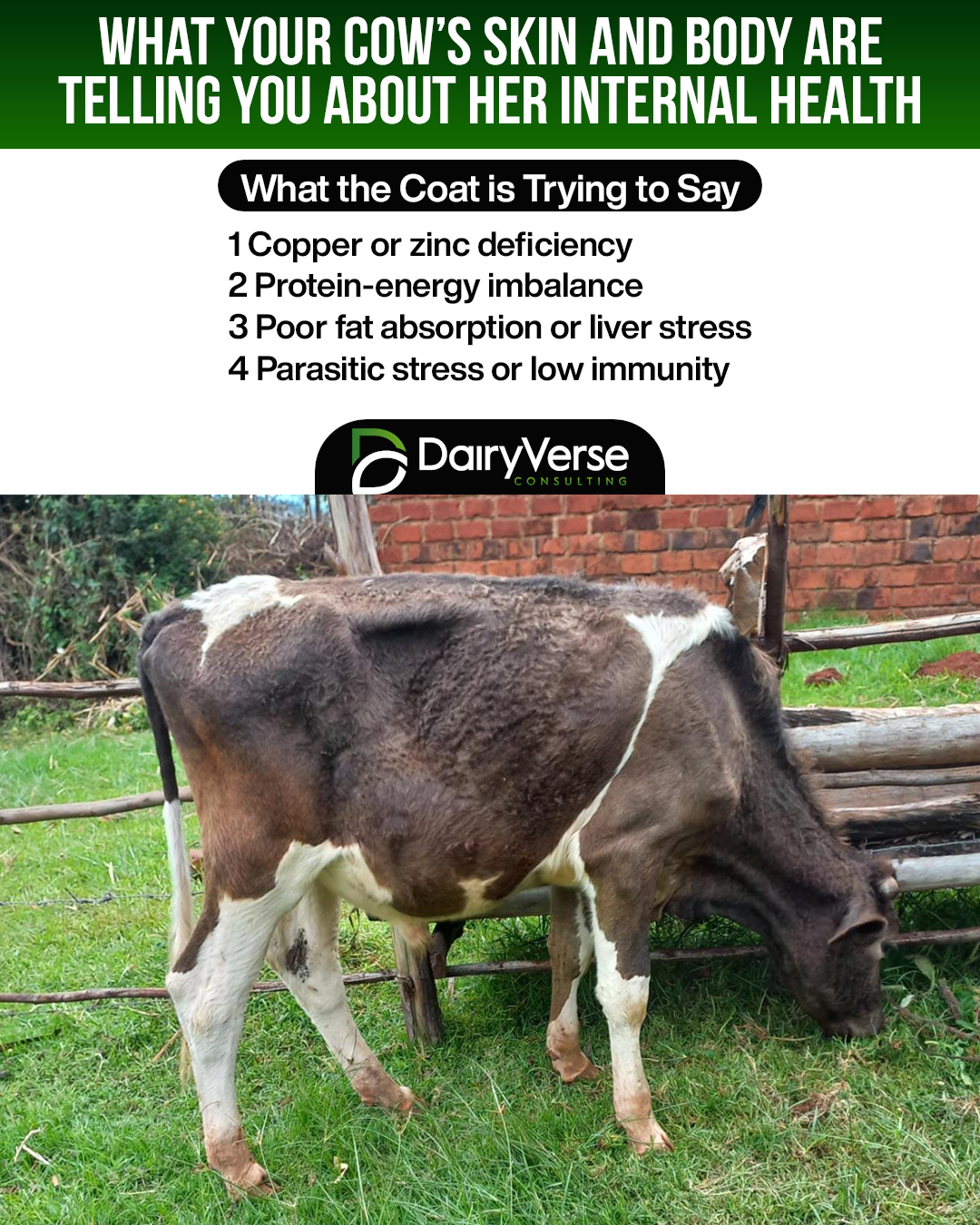
As livestock farmers, we often focus on what we can measure, milk litres, feed amounts, conception rates. But sometimes, the most accurate health indicators are right in front of us, quietly telling a deeper story. A rough, dull coat. A cow that looks thinner despite feeding. Discolored patches around the neck or back. These signs may seem small, but they’re often the first warnings of bigger problems brewing inside.
Coat discoloration and poor body condition are not just cosmetic issues. They’re reflections of your cow’s internal health, especially her nutritional and metabolic balance.
A cow’s coat should be smooth, glossy, and full. When it starts losing shine, becoming patchy, or developing reddish-brown discoloration, it’s usually due to:
These signs are your cow’s way of signaling that her system is under pressure, even before more serious issues like reduced fertility or low milk yield show up.
A cow that “looks thin” doesn’t always mean she’s hungry. Often, she may be eating enough volume but not absorbing what her body truly needs.
Poor body condition can result from:
In these states, the cow begins to draw nutrients from her own body to survive—losing muscle tone, shrinking in frame, and eventually dropping performance.
Ignoring coat and body condition signals can have a long-term cost:
The tragedy? Many farmers unknowingly pour more feed into the cow, hoping for a turnaround, without realizing the root issue lies in mineral formulation, not just quantity.
At Dairyverse, we’ve seen these patterns across farms in different regions. Our response wasn’t just to create a product, but to study the deeper causes of nutrient stress in African livestock.
This led to the creation of RestoreX®, formulated to:
Cows on RestoreX® are showing visible improvements, not just in performance, but in overall appearance, posture, and energy levels. It’s not magic. It’s science, tuned to African realities.
Before the next milk drop or fertility delay catches you by surprise, take a moment to look, really look,at your cows. Their coats. Their ribs. Their posture.
They’re not just standing in your field. They’re talking.
The real question is: Are we listening?